NEXCOM Delivers Optimized Edge Security for Post-Quantum Workloads
TAIPEI, May 7, 2026 /PRNewswire/ -- As quantum computing advances, it introduces cybersecurity risks capable of compromising today's encryption methods. This is accelerating the adoption of post-quantum cryptography (PQC), forcing organizations to rethink how they secure data across distributed environments, especially at the edge. To prepare for this transition, NEXCOM, a leading supplier of network appliances, enables organizations to prepare for PQC today with high-performance, PQC-ready edge cybersecurity solutions.
Unlike traditional cryptography, PQC algorithms rely on larger key sizes and more complex computations, placing increased demands on infrastructure. For enterprises operating edge servers and distributed networks, this creates new performance challenges that require scalable compute, memory, and acceleration capabilities.
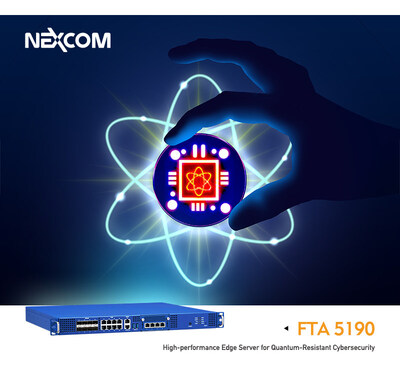
NEXCOM's FTA 5190 edge server is purpose-built for advanced cybersecurity workloads and next-generation encryption requirements. Powered by the Intel® Xeon® 6 SoC with up to 36 performance cores, the compact 1U platform supports up to 128GB DDR5 memory and flexible storage. High-speed connectivity includes eight 25GbE SFP+ ports, eight 1GbE ports, and LAN module slot for scalable network expansion.
To meet the computational intensity of PQC, the FTA 5190 leverages Intel® QuickAssist Technology (QAT), enabling parallel acceleration of cryptographic operations. This allows enterprises to maintain strong encryption and high throughput without compromising latency or consuming critical CPU resources needed for AI and analytics at the edge.
Performance testing validates readiness across current and PQC encryption workloads:
- Up to 3.5K connections per second per core with PQC algorithms
- Up to 2.1x higher TLS throughput in hybrid deployments
- Up to 2x performance improvement with traditional cryptography
NEXCOM FTA 5190 enables a seamless transition to post-quantum cybersecurity, allowing organizations to support today's encryption standards while preparing for a PQC-secured future—without sacrificing performance at the edge. To explore detailed performance insights and test results, please refer to the full solution brief.
About NEXCOM
Founded in 1992 and headquartered in Taipei, Taiwan, NEXCOM is shaping the future of AI-powered networking with its software-defined solutions. Through its Network and Communication Solutions (NCS) unit, NEXCOM delivers cutting-edge platforms for Cybersecurity, OT Security, SD-WAN, SASE, Load Balancing, 5G uCPE, edge AI, and more. NCS specializes in professional design and manufacturing services, enabling reliable and scalable network infrastructures for businesses of all sizes. With a focus on innovation, NEXCOM's solutions empower customers worldwide to build resilient, high-performance networks tailored to the demands of tomorrow's connectivity challenges.
Photo - https://mma.prnewswire.com/media/2973749/3__SD_WAN_Appliance_FTA5190_PR.jpg
 View original content:https://www.prnewswire.co.uk/news-releases/nexcom-delivers-optimized-edge-security-for-post-quantum-workloads-302764828.html