Meet UROVO UPad: The Flagship Commercial Tablet for Connected Frontline Operations
One intelligent platform integrating payment, barcode scanning, RFID, and enterprise mobility
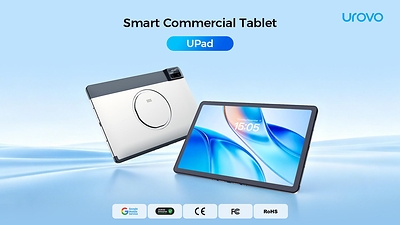
SINGAPORE, Sept. 15, 2026 /PRNewswire/ -- UROVO today introduced UPad, its flagship commercial tablet designed to simplify frontline operations by integrating payment, professional barcode scanning, RFID, and enterprise mobility into a single intelligent platform. By replacing multiple disconnected devices, UPad helps businesses streamline workflows, improve productivity, and gain real-time operational visibility.
"Frontline operations today require more than standalone devices," said Zhang Bo, CTO of UROVO. "UPad brings together payment, data capture, mobility, and business applications in one platform, helping organizations operate more efficiently and deliver better customer experiences."
Built on UROVO's innovative Quick Lock modular architecture, UPad quickly adapts between handheld, countertop, and wall-mounted configurations, allowing a single device to support multiple operational scenarios while reducing hardware investment and simplifying deployment.
UPad is designed for a wide range of industries, including retail for assisted selling, inventory management, and mobile checkout; restaurants for ordering and tableside payment; hospitality for guest services and mobile staff operations; and warehousing and logistics for inventory control and asset tracking.
Powered by a Qualcomm octa-core processor built on an advanced 4 nm process, UPad delivers responsive performance with excellent power efficiency. It features Wi-Fi 6E, optional Wi-Fi HaLow, an 8,000 mAh removable battery, and an 11-inch display that supports glove and wet-touch operation, ensuring reliable performance throughout demanding workdays.
UPad also integrates enterprise technologies into one device, including SoftPOS payments with NFC Tap-to-Pay support, professional barcode scanning, and optional UHF RFID powered by the Impinj E-series chipset with GEN2X support for fast inventory tracking and real-time asset visibility.
Fully integrated with UROVO UMS (Unified Management System), UPad enables IT teams to remotely deploy, configure, monitor, and manage devices from a centralized platform, simplifying large-scale deployments while reducing maintenance costs.
By combining mobility, payment, barcode scanning, RFID, and centralized device management into a unified platform, UPad helps organizations improve operational efficiency, reduce device complexity, and accelerate digital transformation.
Learn more at https://en.urovo.com/.
Contact: urovo@urovo.com
 View original content to download multimedia:https://www.prnewswire.co.uk/news-releases/meet-urovo-upad-the-flagship-commercial-tablet-for-connected-frontline-operations-302852708.html