LG ELECTRONICS' PRISM AI WINS BEST AI TOOL/PRODUCT AT THE 2026 IN2 SABRE AWARDS ASIA-PACIFIC
Delivering Real-Time Insights to Support Strategic Decision-Making,
AI-Powered Communications Platform Redefines PR Measurement Worldwide
News Summary
- LG Electronics' (LG) PRISM AI has won the Best AI Tool or Product category at the 2026 IN2 SABRE Awards Asia-Pacific, recognizing its technological and PR excellence.
- PRISM AI, an AI-powered communications intelligence platform using large language models (LLMs), delivers actionable insights by assessing media coverage, competitive positioning and emerging narratives across 200 markets and 30 brands worldwide.
- This achievement highlights PRISM AI as a model case of LG Group's broader AI Transformation (AX) efforts, demonstrating how AI can reshape global organization operations and setting a new benchmark for the communications industry.
SEOUL, South Korea, Aug. 24, 2026 /PRNewswire/ -- LG Electronics' (LG) proprietary AI-powered communications intelligence platform, PRISM AI, has been awarded one of the industry's most prestigious honors, the Best AI Tool or Product category at the 2026 IN2 (Insight & Innovation) SABRE Awards Asia-Pacific. PRISM AI has also advanced as a finalist for the Consumer Electronics & Telecommunications category at the 2026 SABRE Awards Asia-Pacific.
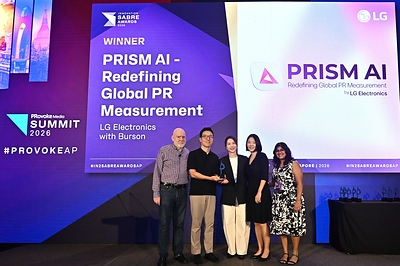
The SABRE Awards Asia-Pacific, presented by PRovoke Media, are among the most respected programs in the global public relations industry, recognizing excellence in branding, reputation and engagement. The IN2 SABRE Awards Asia-Pacific, part of the broader SABRE Awards program, recognizes innovation in the evolving PR landscape, highlighting achievements in areas such as AI, data and analytics, digital engagement and emerging communications technologies.
AI-powered global PR analytics platform, PRISM AI leverages large language models (LLMs) and deep learning to analyze data related to 200 markets and 30 brands worldwide, measure PR performance and deliver strategic insights. By conducting in-depth analysis of millions of news articles, the platform generates key metrics, including PR Score and CI Index, while using context-based keyword analysis and AI Agents to transform complex data into actionable insights and reports. This enables executives and communications professionals to make faster, more objective communications decisions. Its evaluation methodology and measurement metrics have been validated by Burson, a leading global PR consultancy, further strengthening the objectivity and credibility of the platform.
The honor represents comprehensive global recognition of the PRISM AI's innovation, validating both its advanced technological capabilities and tangible value for business. This milestone stands as a premier example of successfully deploying AI technology within real-world communications. By extending its impact beyond a single function to redefine how a global organization operates, PRISM AI sets a new benchmark for AI Transformation (AX) in the industry – solidifying LG's position as a pioneering leader driving the future of data-driven communications.
As LG's group-wide AI transformation efforts gained recognition as a leading example of enterprise-wide innovation, LG sought to bring the same data-driven discipline to its communications activities. With a deep understanding of the growing importance of global communications and the diverse needs of overseas markets, the Overseas Sales and Marketing Company identified the need for a data-driven framework to measure and optimize PR performance worldwide.
"PRISM AI enables us to objectively measure communications impact across markets and derive strategic insights from our activities – supporting LG's business portfolio transformation and differentiated market strategies around the globe," said Thomas Yoon, executive vice president of the Overseas Sales and Marketing Company at LG Electronics. "It is an indispensable tool for making more informed decisions with greater speed and precision."
"Combining LG's global PR expertise with advanced AX capabilities, PRISM AI represents something few companies can replicate," added Cho Jung-bum, head of the AX Center of CSO at LG Electronics. "PRISM AI exemplifies how AX is taking root not only within LG Electronics but across LG Group as a whole — moving beyond individual tools to reshape how LG operates."
About LG Electronics, Inc.
LG Electronics is a global innovator in technology and consumer electronics with a presence in almost every country and an international workforce of more than 75,000. LG's four Companies – Home Appliance Solution, Media Entertainment Solution, Vehicle Solution and Eco Solution – combined for global revenue of over KRW 89 trillion in 2025. LG is a leading manufacturer of consumer and commercial products ranging from TVs, home appliances, air solutions, monitors, automotive components and solutions, and its premium LG SIGNATURE and intelligent LG ThinQ brands are familiar names world over. Visit www.LG.com/global/newsroom/ for the latest news.
 View original content to download multimedia:https://www.prnewswire.co.uk/news-releases/lg-electronics-prism-ai-wins-best-ai-toolproduct-at-the-2026-in2-sabre-awards-asia-pacific-302858244.html